The hidden complexity behind simple B2B messaging
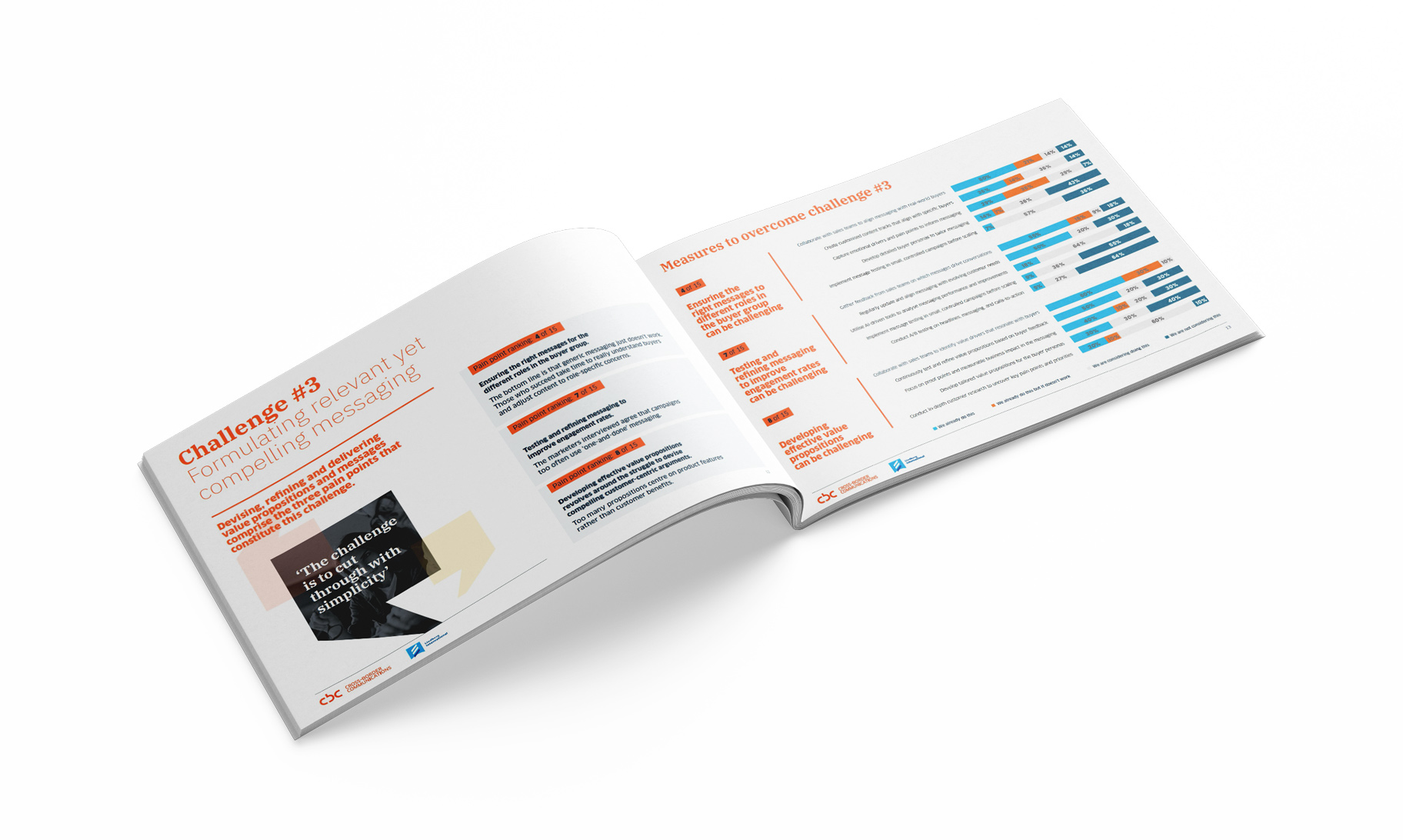
Our survey of 20 CMOs from leading Danish B2B businesses was developed in collaboration between CBC and Lindberg International and revealed the 5 core marketing challenges of 2026. This post examines challenge number three: formulating relevant yet compelling messaging.
At first glance, formulating relevant yet compelling messaging sounds like a familiar – indeed routine – marketing task. In reality, it has become a significant challenge that according to our survey is driven by three core issues:
- ensuring the right messages reach different roles in the buying group
- developing effective value propositions
- testing and refining messaging to improve engagement
Or, as our report on the survey puts it: ‘the challenge is to cut through with simplicity.’
Complexity makes clarity harder
The difficulty, quite simply, lies in the nature of today’s buying environment.
B2B buying decisions are no longer made by individuals, but by groups – often large, cross-functional entities that evolve over time. Engineering, procurement, finance, IT, ESG and senior leadership may all be involved, each with different priorities and concerns.
This creates a fundamental messaging challenge. What resonates with one stakeholder may be irrelevant to another. A technical argument may convince engineering but fail to engage finance. A sustainability message may land with ESG but not address operational risk. And even strong product features may not answer the broader strategic questions senior decision-makers care about.
This is why generic messaging no longer works. Companies that succeed are those that understand how different stakeholders think and can adapt their messaging accordingly.
More B2B insights: Understanding B2B buying centres: hard work with big rewards
The limits of product-led messaging
Despite this, many organisations still communicate from the inside out.
Messaging tends to focus on products, features and technical strengths. While accurate, this approach rarely addresses what buyers actually need to move forward with a decision.
In complex buying processes, messaging must do more than describe what a solution does. It must explain what it means. How does it reduce risk? Improve efficiency? Deliver measurable business impact? How does it help stakeholders justify the decision internally?
This is where value propositions often fall short. Too many remain centred on what the company offers, rather than what the customer gains. The consequence is not just weaker messaging, but weaker commercial outcomes – because unclear value makes it harder for buying groups to align.
More B2B insights: Purpose-driven branding: show them what you stand for, not just what you sell
Messaging is a process, not a deliverable
A further challenge is how messaging is developed and applied.
Many campaigns still rely on ‘one-and-done’ messaging – created once and rolled out broadly without sufficient testing or refinement. In a dynamic buying environment, that approach is increasingly ineffective.
Effective messaging is iterative. It requires continuous input from the market, from customers and from sales teams. Which messages open conversations? Which objections come up repeatedly? What builds confidence – and what creates hesitation?
The most effective organisations treat messaging as an ongoing process rather than a fixed output. They test, learn and refine over time, using real-world feedback to improve relevance and impact.
From insight to impact
For CMOs and marketing leaders, the implication is clear: Relevant and compelling messaging does not start with creative execution. It starts with a precise understanding of how customers actually buy – and what different stakeholders need to see, understand and believe in order to move forward.
That, however, requires closer alignment between marketing, sales and leadership, and a shift from internal assumptions to external reality.
From there, the task is not to say more – but to say what matters. To translate complexity into clarity, and to give buying groups the confidence to act.
In 2026, the companies that succeed will not be those with the most messaging, but those whose messaging makes the decision easier.
More B2B insights: How to stop information overload from killing B2B deals
Interested in the full report or in continuing the conversation?
Reach out to Ralph Krøyer, Managing Partner at CBC, to receive the full report ‘The 5 core B2B marketing challenges for 2026’, with further insights and stats on challenge #3 plus the four other key B2B marketing challenges. You can reach him at rk@cbc.dk or +45 35 25 01 60.