How you reach and influence B2B decision makers has changed. Here's why.
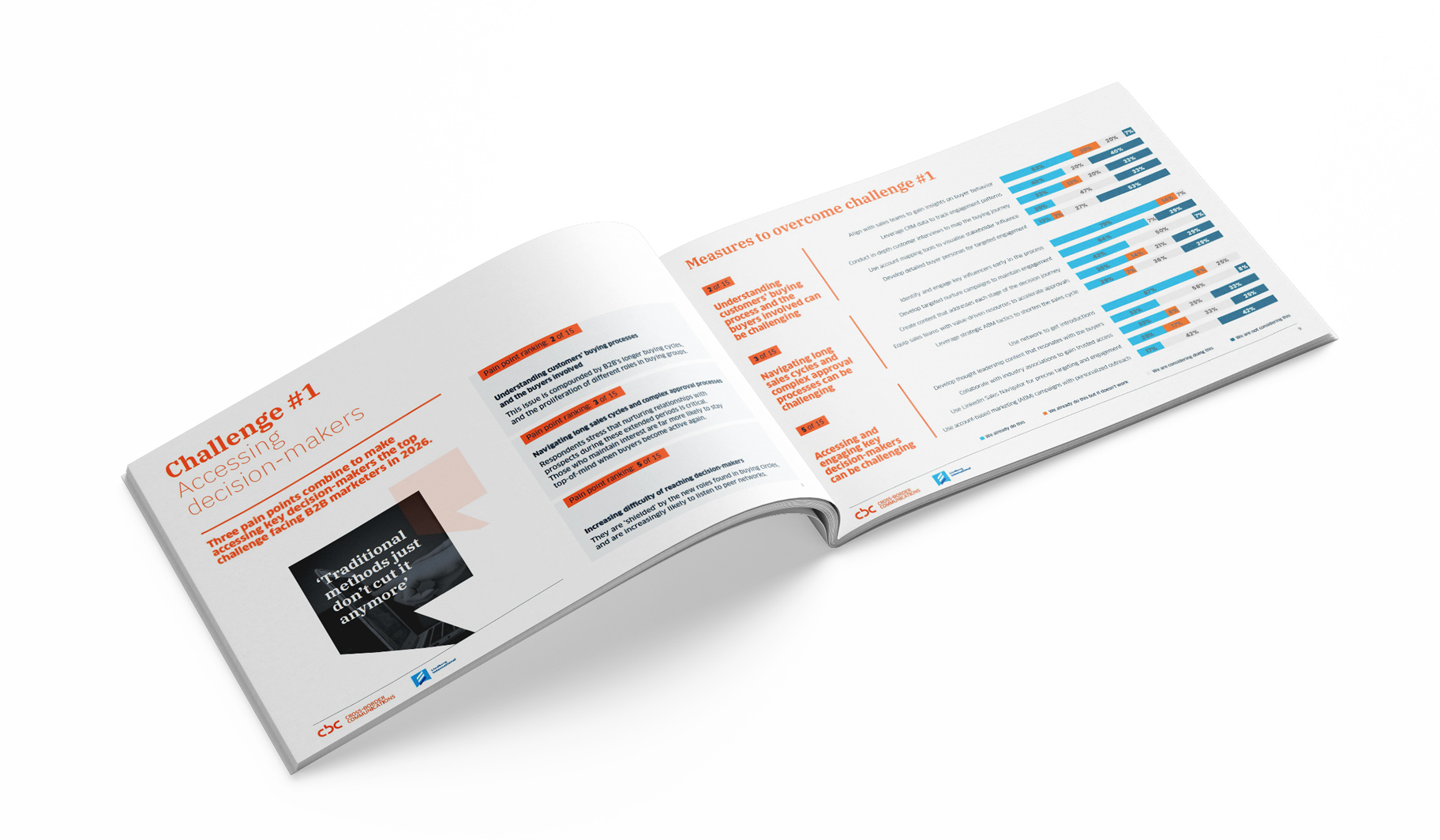
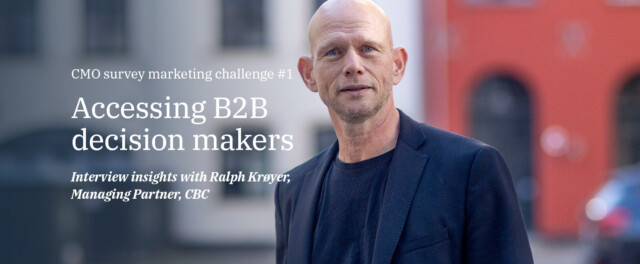
Our survey of 20 CMOs from leading Danish B2B businesses was developed in collaboration between CBC and Lindberg International to identify the five core marketing challenges shaping 2026. We spoke to Ralph Krøyer, Managing Partner, Cross-Border Communications, to get his insights into challenge number one: accessing B2B decision makers.
Q: The CMO report identifies ‘accessing decision-makers’ as the primary challenge for B2B marketers. Why is this such a critical issue?
The idea of a ‘decision maker’ has fundamentally changed. In most B2B environments today, you’re not dealing with one person, you’re dealing with a buying group that can easily include 5, 10, sometimes 20 stakeholders, all with different priorities.
What’s happened is that access hasn’t just become harder; it has become more indirect. The people you ultimately need to influence are now buffered by layers of internal stakeholders and external input. That makes traditional outreach far less effective than it used to be.
Q: The report also highlights that understanding the B2B buying process itself is a major pain point. Why are companies struggling with that?
It’s because most organisations still operate on outdated assumptions about how buying decisions are made. They think in terms of linear funnels. But in reality, buying journeys today are non-linear, political, and often opaque. Stakeholders come in and out. Priorities shift. And decisions can stall for months or even years.
What we often see is that companies haven’t properly mapped who actually influences the decision versus who signs it off. That gap is critical. If you don’t understand the real dynamics inside the buying group, you’re essentially marketing blind.
More B2B insights: Understanding B2B buying centres: hard work with big rewards
Q: Another pain point mentioned is long sales cycles and complex approval processes. How does that impact marketing?
It completely changes the role of marketing.
If your sales cycle runs over 18 to 36 months, which is increasingly common, then marketing isn’t just about generating leads. It’s about sustaining relevance over time.
The companies that succeed are the ones that stay visible and credible throughout that entire period. Not just when the buyer is active, but also when they’re not.
That requires a very different mindset. You need to think in terms of long-term influence rather than short-term conversion. And that’s where many marketing organisations are still catching up.
More B2B insights: More B2B sales? Don’t forget memory generation
Q: The report mentions that decision-makers are increasingly “shielded” and rely more on peer networks. What does that mean in practice?
It means you’re no longer the primary source of information.
Buyers trust peers, industry networks, and independent sources far more than they trust vendors. So even if you’re producing strong content, you’re often not where the real conversations are happening.
This is why thought leadership and credibility have become so important. You’re not just competing for attention; you’re competing for trust in an environment where access is mediated by others.
More B2B insights: A mission for marketing: engaging C-suite leaders in the buying centre
Q: So if traditional methods don’t work anymore, what should B2B companies be doing differently?
First, they need to accept that access is earned, not assumed.
That means investing in understanding the buying group properly, not just personas, but real influence structures. Who shapes the agenda? Who challenges decisions? Who blocks them?
Second, they need to align much more closely with sales. Sales teams often have fragmented but valuable insights into how deals actually progress. That intelligence needs to be systematically captured and used.
More B2B insights: If B2B buyers don’t trust sellers (fact), how can you win them over?
And third, they need to rethink how they show up in the market. It’s less about pushing messages and more about building presence through content, networks, partnerships, and visibility in the right contexts.
Q: Many companies are already using tactics like ABM, LinkedIn outreach, and thought leadership. Yet the report suggests these often don’t work as expected. Why?
This is often because tactics are being applied without a clear strategic foundation. Account-based marketing, for example, only works if you truly understand the account, including the stakeholders, the dynamics, the timing, etc. Otherwise, it just becomes targeted noise.
The same goes for content. A lot of companies produce thought leadership, but it’s inward-looking. It reflects what they want to say, not what buyers actually need at different stages of the decision process.
So the issue isn’t the tools; it’s the lack of clarity behind them.
Q: If you had to give one piece of advice to CMOs facing this challenge, what would it be?
Stop thinking in terms of campaigns and start thinking in terms of influence.
Campaigns assume a level of access and control that no longer exists. Influence is about being present in the right places, with the right messages, over time.
The companies that get this right are the ones that understand how their customers actually buy, and build their marketing around that reality, not around internal structures or legacy thinking.
Q: And where does CBC come in? How do you help companies tackle this challenge?
What we typically see is a lack of clear direction. Companies know the market has changed, but they haven’t translated that into a coherent marketing approach.
At CBC, we help bridge that gap. We work with leadership teams to clarify positioning, align marketing with how buyers actually behave, and build strategies that create visibility and credibility across long, complex B2B buying journeys.
Because ultimately, access to decision-makers isn’t a channel problem. It’s a strategic clarity problem.
Interested in the full report or in continuing the conversation?
Reach out to Ralph Krøyer, Managing Partner at CBC, to receive the full report ‘The 5 core B2B marketing challenges for 2026’, with further insights and stats on challenge #1 plus the four other key B2B marketing challenges. You can reach him at rk@cbc.dk or +45 35 25 01 60.