Why leading B2B companies are experiencing growing complexity in ROI measurement
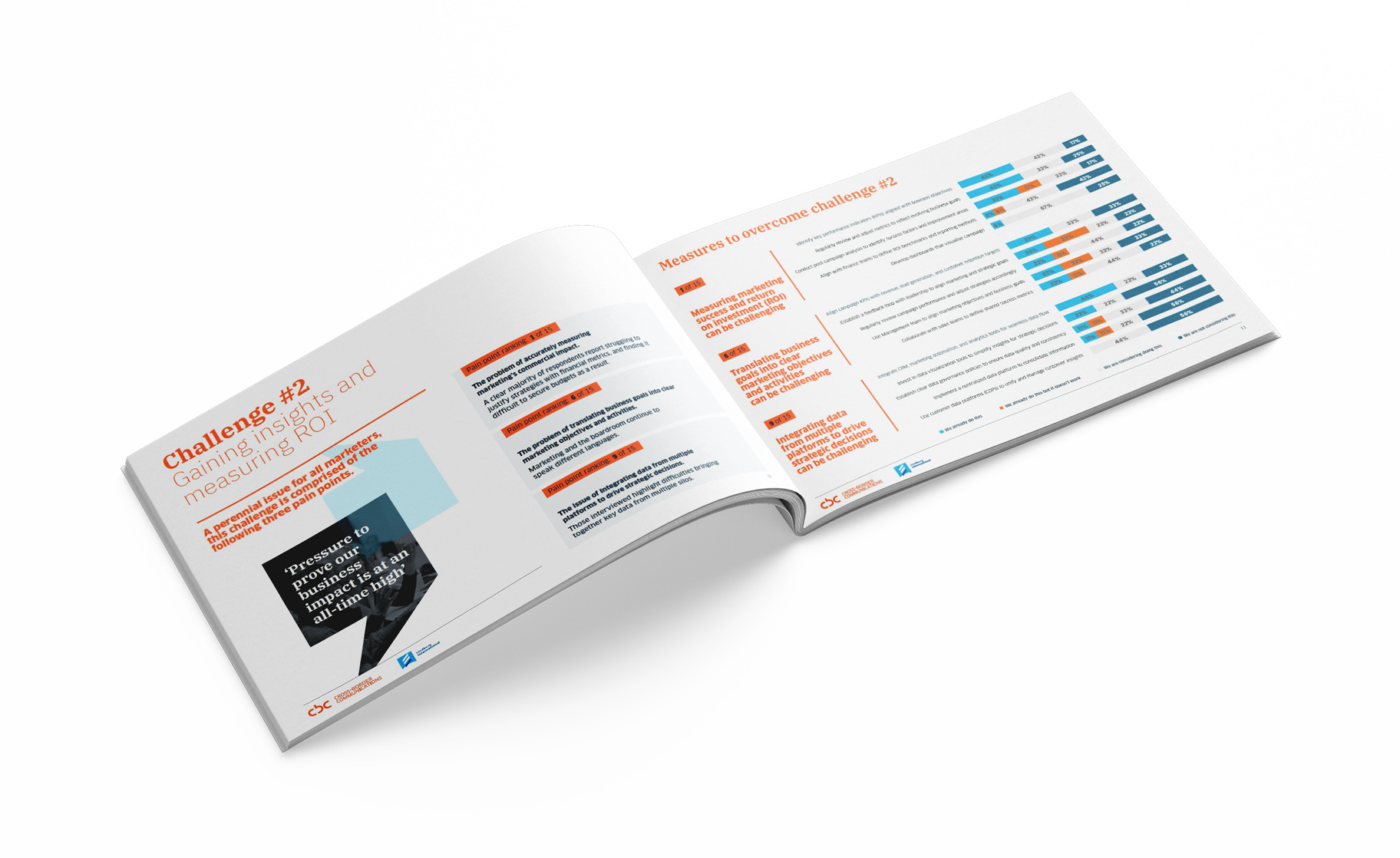
Our survey of 20 CMOs from leading Danish B2B businesses was developed in collaboration between CBC and Lindberg International to identify the five core marketing challenges shaping 2026. We spoke to Michael Lindberg, Managing Director of Lindberg International, to get his perspective on challenge number two: gaining insights and measuring ROI.

Q: The report highlights ‘gaining insights and measuring ROI’ as a core challenge. Why is this still such a persistent issue?
I think a big part of the challenge is that B2B buying processes have become much more complex than they used to be.
In many of the companies we work with, buying cycles stretch over 6–18 months and involve multiple stakeholders across different functions and levels of the organisation. It is rarely a straightforward process anymore.
The difficulty is that many of the measurement approaches companies rely on were originally built for a much simpler buying environment. Today, influence builds gradually over time and across different touchpoints, which naturally makes ROI harder to isolate and interpret clearly.
So it is not just a measurement issue. It is really about understanding how buying decisions are actually made today.
Q: Measuring marketing success and ROI was identified as the biggest pain point in the report. Why do so many companies struggle with this today?
Quite simply, expectations towards marketing have changed significantly in recent years.
Marketing is no longer viewed as a support function. It is expected to contribute directly to growth and commercial performance, which means leadership teams naturally want clearer evidence of impact and ROI.
More B2B insights: Convince the C-suite: how marketing can win the B2B budget battle
At the same time, many companies are operating under tighter budgets and increasing pressure to do more with less. That creates a difficult balance.
The challenge is that marketing outcomes rarely happen in isolation. Results are shaped across sales, leadership, product, customer experience, and multiple interactions over time.
So while the demand for clarity has increased, the commercial environment itself has become much harder to measure in a simple way. That tension is something most B2B marketers are dealing with right now.
Q: Many companies already track a wide range of marketing metrics. Why is that often not enough?
Most companies already have access to a huge amount of data. The real challenge is figuring out which insights actually matter commercially.
Most organisations are very good at tracking activity. They know how many leads they generated, how many clicks they received, and how campaigns performed from an engagement perspective.
But activity metrics alone do not always show whether you are genuinely building momentum with the right buyers.
For example, we recently worked with a company that generated a very high volume of leads, but the bigger challenge was converting that activity into meaningful commercial dialogue and long-term opportunities.
What really matters is understanding whether marketing is helping move decisions forward. Are we influencing the right stakeholders? Are we reducing uncertainty? Are we strengthening trust and credibility over time?
More B2B insights: Influencing the influencers. How stakeholder mapping drives better B2B marketing
Without that connection to how decisions are actually made, ROI can quickly become difficult to interpret in a meaningful commercial context.
Q: The report also highlights difficulties translating business goals into clear marketing objectives. Why is that such a common issue?
Because the translation is rarely as straightforward as it first appears.
A business goal like “we want to grow in Germany” sounds quite clear on paper. But once you begin looking closer, a lot of important questions emerge.
Who exactly are we trying to influence? What matters most to those buyers? How are decisions made internally? What typically slows the process down?
We often see situations where companies initially assume one thing is holding growth back, only to discover that the real issue is something entirely different.
Without clarity around those underlying dynamics, marketing objectives can easily become too broad or disconnected from how customers actually buy. And once that happens, measurement becomes much harder to make meaningful.
Q: The report also points to data integration as a major issue affecting marketing insight and ROI measurement. What is the underlying challenge here?
A lot of it comes down to fragmentation.
Most companies have invested in CRM systems, marketing automation platforms, analytics tools, and reporting dashboards. But the data is often spread across different functions, and teams do not always interpret it in the same way.
Sales might focus on pipeline movement. Marketing looks at engagement and lead quality. Leadership focuses on revenue forecasts and growth targets.
All of those perspectives are relevant, but they do not always connect clearly.
In fact, we often see situations where marketing reports strong campaign performance, while sales still feels they are not seeing stronger commercial momentum. Both perspectives can be valid at the same time, which is exactly what makes alignment so important.
Without a shared understanding of what success actually looks like, ROI quickly becomes something different teams interpret differently.
Q: So are the difficulties around marketing measurement and ROI primarily a technology problem?
Technology obviously matters, but in most cases the bigger challenge is creating a shared understanding of what the business is actually trying to learn from the data.
Sometimes companies invest heavily in reporting capabilities before they have fully aligned on which commercial questions they are trying to answer.
You can have very advanced reporting in place and still struggle to understand what genuinely influenced a buying decision.
Insight does not come from tools alone. It comes from combining data with a clear understanding of the market, the customer, and how decisions are made across the buying journey.
Q: What role does customer insight play in improving marketing measurement and ROI?
It is absolutely central.
If you understand how your customers make decisions, you can begin to see where marketing actually creates value.
In many B2B buying processes, the real shift does not happen because of one individual campaign. It happens gradually, as confidence builds across the buying group over time.
So instead of asking, “Which campaign generated this lead?”, a more useful question is often, “What contributed to this decision?”
That creates a much more realistic way of thinking about ROI. Less about isolated attribution, and more about long-term influence and commercial confidence.
Q: The report suggests closer alignment between marketing, sales, and leadership. Why is that so important?
Because no single function has the full picture on its own.
Sales understands how opportunities progress and where they tend to stall. Marketing understands how buyers engage with the market and how visibility and influence are built over time. Leadership defines the broader commercial priorities.
If those perspectives are not aligned, companies often end up measuring success in different ways across the organisation.
But when there is alignment around shared priorities and shared definitions of success, marketing measurement becomes significantly more meaningful and commercially relevant.
More B2B insights: Double your strength with sales and marketing alignment
Q: If you had to highlight one common mistake companies make when trying to measure marketing ROI, what would it be?
Probably trying to simplify ROI too early in the process.
There is often understandable pressure to demonstrate impact quickly, especially as expectations towards marketing continue to increase.
But if companies have not first aligned around what actually drives commercial success in their market, measurement can easily become disconnected from the reality of how buying decisions happen.
The strongest companies tend to spend more time upfront understanding their customers, validating assumptions, and agreeing internally on what meaningful progress actually looks like.
Once that foundation is in place, measurement becomes much more useful and much easier to stand behind.
Q: What is your main advice to CMOs trying to improve marketing insight and ROI measurement?
I think the strongest companies spend more time understanding how their customers actually buy before they try to optimise measurement.
Measurement obviously matters. But in most cases, good measurement is really the outcome of having clarity around the market, the customer, and the commercial strategy.
The companies that handle this well tend to challenge assumptions early, stay closely aligned internally, and focus on understanding what genuinely influences buying decisions over time.
When that foundation is in place, ROI becomes much easier to interpret in a meaningful way.
Q: And how does Lindberg International help companies improve customer insight and ROI measurement?
At Lindberg International, we help companies make more confident commercial decisions by combining market insight with practical commercial consulting.
That means helping businesses better understand their customers, markets, and competitive realities — and translating those insights into clearer priorities and more focused commercial direction.
In many cases, the challenge is not a lack of data. It is making sense of which data actually matters commercially.
Because ultimately, access to decision-makers isn’t a channel problem. It’s a strategic clarity problem.
Interested in the full report or in continuing the conversation?
Reach out to Ralph Krøyer, Managing Partner at CBC, to receive the full report ‘The 5 core B2B marketing challenges for 2026’, with further insights and stats on challenge #2 plus the four other key B2B marketing challenges. You can reach him at rk@cbc.dk or +45 35 25 01 60.